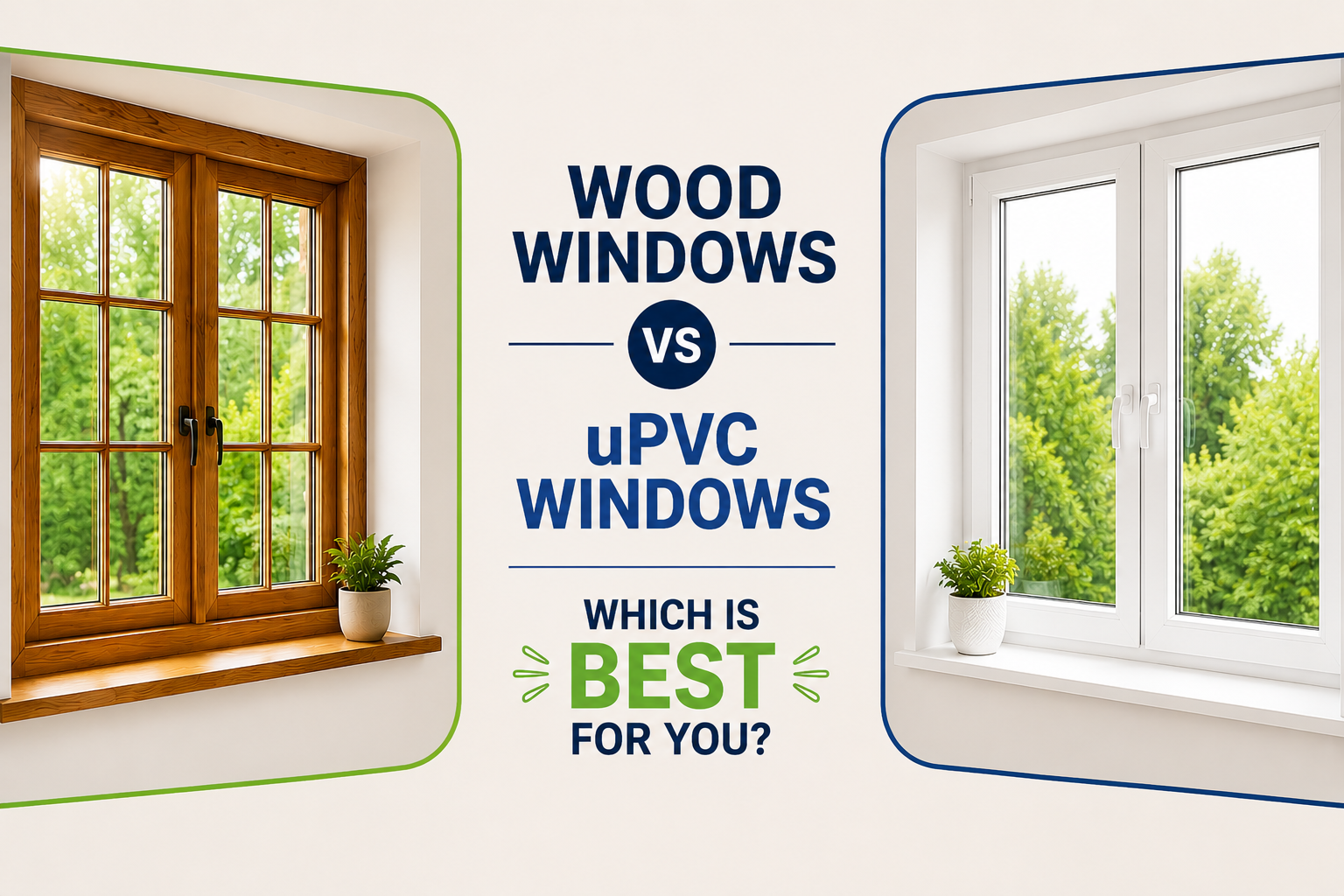
For more than 20 years, the team at Green Fenster has worked with homeowners, architects, and builders across different types of residential projects. One question that consistently comes up during consultations is: “Which is better for my home wood windows or uPVC windows?”
Many homeowners love the timeless look of wooden windows, while others prefer the durability and low maintenance of uPVC. The confusion usually begins when trying to balance appearance, budget, maintenance, weather resistance, and long-term performance. Over the years, we’ve seen that there is no one-size-fits-all answer — the right choice depends entirely on your home’s design, climate conditions, and lifestyle needs.
In this guide, we’ll share the practical differences between wood and uPVC windows based on real industry experience, helping you understand which option is the better investment for your home.
What exactly is a uPVC Window?
uPVC stands for Unplasticised Polyvinyl Chloride, a strong and durable material commonly used for modern windows and doors. It became popular in homes because it is long-lasting, weather-resistant, and requires very little maintenance compared to traditional materials like wood.
Unlike regular plastic, uPVC is rigid and sturdy, which helps the window frames keep their shape for many years without warping, rotting, or corroding. That’s one of the main reasons why uPVC windows are widely used in modern homes today.
Modern uPVC windows are also available in a variety of colours, designs, and wood-like finishes, giving homeowners the appearance of timber without the high maintenance. Once installed, they usually only need occasional cleaning to stay in good condition.
What About Wood Windows?
Timber windows have been a staple of British homes for centuries, and their appeal has faded. Whether it's the grain of an oak frame or the classic painted softwood of a Victorian terrace, wooden windows carry a warmth and character that's hard to manufacture.
They can be crafted from softwoods such as pine and spruce, or denser hardwoods like oak, teak, or mahogany. Each species brings different performance qualities, price points, and maintenance demands so "wood windows" is really an umbrella term covering quite a broad range of products.
Key Differences A Straight Comparison
1. Cost - Who Takes the Hit on Your Wallet?
If upfront spend is a deciding factor, uPVC wins this round comfortably. Both the frames themselves and the labour involved in fitting them tend to cost less than equivalent timber options. Hardwood windows in particular sit at the premium end of the market, and the gap in price can be significant.
That said, cost over time is a different conversation. A set of quality wooden windows that receives consistent care can stay in excellent condition for well over half a century. uPVC has a shorter service life typically somewhere between 20 and 35 years before age starts showing through discoloration or frame brittleness.
So while uPVC is cheaper to buy, wood can be cheaper to own over the very long term, provided the maintenance commitment is met.
2. Durability — Which One Actually Lasts?
Hardwood windows, properly looked after, genuinely outlast uPVC. Sixty years isn't an unrealistic expectation for a quality timber frame that's been maintained well. uPVC, despite its resistance to rot and dampness, eventually degrades under prolonged UV exposure and general wear.
The catch with wood, of course, is that "properly looked after" is doing a lot of work in that sentence. Without regular treatment, timber becomes vulnerable to swelling, rot, and insect damage relatively quickly. A neglected wooden window will fail far sooner than a neglected uPVC one.
3. Maintenance — What Are You Signing Up For?
This is where uPVC pulls well ahead for most busy households. Cleaning a uPVC window frame is a five-minute job with a damp cloth. There's no painting, no staining, no annual treatment required. Once they're in, they largely look after themselves.
Wooden windows demand more of a relationship. Every three to five years — sometimes more frequently depending on weather exposure — they need sanding, treating, or repainting to keep moisture and UV rays from doing damage. It's not an enormous task, but it is a recurring one. If that kind of upkeep genuinely appeals to you (some homeowners genuinely enjoy it), great. If it sounds like a chore you'll keep putting off, uPVC is almost certainly the better fit.
4. Energy Efficiency — Does Material Actually Matter?
In terms of thermal performance, both window types are capable of excellent results — and the glazing specification matters at least as much as the frame material itself. Modern uPVC frames with high-quality double or triple glazing perform strongly, and the material naturally handles heat and condensation well.
Timber is a natural thermal insulator and, when paired with performance glazing, can match uPVC closely. The weakness tends to show in older or poorly fitted wooden frames, where small gaps allow draughts in over time. New, well-installed timber windows shouldn't have that problem.
If you're in a particularly hot climate, uPVC's greater heat resistance gives it a practical edge day to day.
5. Appearance — Does It Look the Part?
On aesthetics, most people's instincts lead them the same way: for a traditional home, timber just looks right. The natural grain, the depth of a painted hardwood frame, the way light catches real wood — it's genuinely difficult to replicate artificially, even with today's woodgrain-effect uPVC finishes.
For contemporary architecture or modern builds, the equation shifts. uPVC's clean lines and consistent finish suit newer homes well, and the colour range available has grown enormously. White uPVC is still common, but anthracite grey, cream, and various other shades are all widely available.
Ultimately, aesthetics are personal — but the type of property you're working with usually points you in a fairly obvious direction.
6. Environmental Credentials — Which Is the Greener Choice?
Wood from sustainably certified forests — look for FSC or PEFC labelling — is a renewable material with a far lower carbon footprint than plastic. At the end of its life, it can be composted or repurposed rather than sent to landfill.
uPVC's environmental story is more complicated. Manufacturing it involves chlorine-based chemicals, and while the material can technically be recycled, the infrastructure for doing so isn't consistent. Disposal at the end of life remains a genuine concern.
If sustainability matters to you, timber from a certified source is the more responsible choice. The caveat is that poorly sourced tropical hardwoods carry their own environmental cost, so checking certification before purchasing is important.
7. Security — Can You Trust Either to Keep You Safe?
Both window types can be made very secure, and neither has an inherent structural weakness when specified correctly. Most uPVC windows now come with multi-point locking systems as a standard feature rather than an upgrade, which is reassuring.
Quality hardwood windows fitted with modern locking hardware are equally capable of resisting forced entry. The risk with wooden windows tends to come at the budget end of the market, where thinner or lower quality frames may be easier to compromise. Specified properly, timber is no less secure than uPVC.
8. Property Type — Does Your Home Have a Say?
In some cases, the decision is partly made for you. Properties in conservation areas or those with listed building status are often subject to planning restrictions that require windows to be replaced in matching or sympathetic materials, usually timber. If you're in any doubt, check with your local planning authority before committing to either option.
For standard modern homes, there are no such restrictions and both materials are equally viable. For new builds, uPVC tends to be the default precisely because it's cost-effective and requires little from future occupants.
One to one Straight Comparison
|
uPVC Windows |
Wood Windows |
|
|
Upfront Cost |
Lower |
Higher |
|
Lifespan |
20–35 years |
60+ years (with care) |
|
Maintenance Required |
Minimal |
Regular (every 3–5 yrs) |
|
Thermal Performance |
Excellent |
Excellent |
|
Appearance |
Modern / contemporary |
Traditional / natural |
|
Sustainability |
Limited |
Strong (if certified) |
|
Security |
High |
High (quality hardware) |
|
Conservation Areas |
Often restricted |
Usually required |
Which One Is Right for You?
uPVC makes more sense if
-
You want windows that largely take care of themselves
-
Your property is a modern or new-build home
-
Your primary driver is keeping costs down
-
You live somewhere warm or exposed to high humidity
Wood is the better choice if
-
Your home is a period property, listed building, or in a conservation area
-
The look and character of natural timber is important to you
-
You're comfortable with periodic maintenance as part of home ownership
-
Sustainability and long-term environmental impact factor into your decisions
Making the Final Call
Neither wood or uPVC windows are completely better than the other; both are designed for different needs and different types of homes. uPVC windows are popular for their low maintenance, affordability, and modern performance, while wooden windows are valued for their natural appearance, premium feel, and long lifespan.
The best choice depends on what matters most to you. If you want easy maintenance and long-term durability, uPVC windows can be the right option. If you prefer a classic and elegant look, wooden windows may suit your home better.
Before making a final decision, it’s always a good idea to speak with an experienced window specialist who can explain the advantages of both options based on your home design, budget, and climate conditions. Seeing actual window samples in your space can also help you understand which style fits your property best.
If you’re looking for expert guidance in choosing the right windows for your home, the team at Green Fenster is here to help. With over 20 years of experience in the uPVC windows industry, we help homeowners find window solutions that match their style, budget, and long-term needs.
Contact us today for a free consultation and get expert advice on selecting the best windows for your home.